

Japan is also known to have a long history of steel and sword manufacturing. Following the prohibition of samurai swords, a lot of these artisans began to make kitchen knives.
The Japanese knife market had a revenue of USD 146.5 million in 2021. It is projected to hit USD 285.3 million by 2030, according to reports. Japanese knives, such as Gyuto and Santoku, possess accuracy, aesthetics, and balance, an aspect that makes them very special. However, when you are a beginner, it may be difficult to figure out which Japanese knives best suit your needs.
The Japanese knife market had a revenue of USD 146.5 million in 2021. It is projected to hit USD 285.3 million by 2030, according to reports. Japanese knives, such as Gyuto and Santoku, possess accuracy, aesthetics, and balance, an aspect that makes them very special. However, when you are a beginner, it may be difficult to figure out which Japanese knives best suit your needs.
Don’t worry! In this guide, we will break it all down for you. We’ll explore what makes Japanese knives stand out and what features beginners should look for.
Why are Japanese Knives the Best in the Market?
So, what is the specialty of Japanese knives? Well, it is in their craftsmanship. Japanese blades are thin, sharp, and lightweight, making them effective for clean cutting and easy handling.
It is not only the features, but also the market statistics that testify to the growth of the knife industry. If you’re thinking, do chefs also prefer Japanese knives? The answer is absolutely yes. They prefer to use Japanese knives for their sharpness and precision.
What Features Should a Beginner’s Knife Have?
A beginner should look for:
- Blade material: Choose stainless or molybdenum steel. They are easier to sharpen and they resist rust, which is suited to first-time users.
- Handle design: The handle must be comfortable and cause less fatigue in case of prolonged cooking hours.
- Blade length: Gyuto knives of 8-inch and Santoku knives of 7-inch are always good for beginners, as they provide good control.
- Ease of sharpening: Softer steels (around HRC 56–58) are more forgiving and easier to maintain.
- Weight and balance: Lightweight knives are used to ease the strain and enhance accuracy.
These parameters often determine a knife's quality and its lifespan.
Top Japanese Knife Categories You Start With
Gyuto Knives
The Gyuto is Japan’s version of the Western chef’s knife - versatile, balanced, and suited for just about everything.
Best for:
- Slicing, chopping, and dicing vegetables
- Cutting meat and fish with precision
Why would you love it?
The Gyuto’s long, pointed blade allows for smooth rocking motions and fine control. It’s the go-to knife if you want one that “does it all.”
Pro tip and top picks
Choose a Gyuto knife with a slightly curved edge if you often use Western cutting techniques. Go with Kazoku Takahiro Gyuto or Kazoku Ginsan Nashiji Gyuto as a beginner. Then gradually shift to the bigger knives like the Kazoku Mabushii Gyuto 24 cm.
Santoku Knives
The Santoku, meaning “three virtues,” excels in cutting meat, fish, and vegetables, making it a kitchen workhorse.
Best for:
- Every day prep like chopping onions, slicing chicken, or mincing herbs
- Home cooks who prefer a lighter, shorter blade
Why it’s popular:
It’s compact, easy to handle, and incredibly sharp. The Santoku knife’s flat edge makes clean, precise cuts without much rocking motion.
Pro tip and top picks
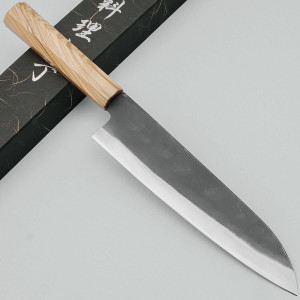
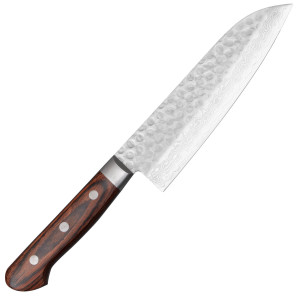
Many Santoku knives come with a Granton edge. The small dimples that reduce food sticking to the blade. You can safely try the Kazoku Takahiro Santoku 18 cm or the Kazoku Uteki Burlwood Green Gyuto as a beginner.
Nakiri Knives
The Nakiri knife is a straight-edged, rectangular blade crafted specifically for vegetables. It’s designed to slice cleanly through even the toughest roots or softest greens.
Best for:
- Chopping, shredding, and dicing vegetables
- Creating paper-thin slices for salads or garnishes
Why is it unique?
The Nakiri’s double-edged flat blade ensures precise, straight cuts, no rocking, no tearing. If you cook lots of plant-based meals, this is your best friend.
Pro tip and top picks
Use a gentle up-and-down motion instead of rocking for perfect vegetable cuts every time. As a beginner, your safe bet is to go with the Kazoku Mabushii Nakiri 16.5 cm or the Kazoku Kagami Nakiri 17 cm.
Bunka Knives
The Bunka knife combines the versatility of a Santoku with the precision of a Gyuto. It’s known for its distinctive k-tip (angled tip), giving it a bold, modern look and added functionality.
Best for:
- Detailed slicing and dicing
- Chopping herbs, garlic, and small vegetables
- Quick, controlled cuts
Why is it popular?
The Bunka knife’s sharp tip is perfect for precision work, while its flat edge handles everyday prep effortlessly. It’s an excellent alternative for those who want a unique, all-purpose knife with character.
Pro tip and top picks
Start with knives like the Kazoku Kage Aogami Bunka for a safe and precise experience.
Why are Kazoku Knives a Great Choice for Beginners?
There is a quote by Abraham Lincoln, “If I get 8 hours to cut a tree, I'll spend 7 hours to sharpen my knife.”
But in the kitchen, we don’t have 7 hours to sharpen the knife. So we need to ensure we get an already sharp one that reduces the time spent cutting and chopping. Kazoku Knives addressed this need. They designed the knives to make cutting feel natural.
The Kazoku Uteki Series
The Kazoku Uteki Series is a premium choice known for its refined craftsmanship and performance. It features high-quality Japanese steel that offers excellent sharpness and edge retention, along with a well-balanced design and an ergonomic handle for precise, comfortable control.
Kazoku Takahiro
The other popular model in the Takahiro series is the Santoku Knife. It is usually very sharp, and with a blade length of 16.5 cm, it is the best fit between professionals and beginners.
Kazoku Aogami Super Tsuchime
The Aogami Super Tsuchime series is made for those who demand high sharpness and durability. Their blades are made with Aogami Blue Paper Super steel, known for its harder and tougher grip.
If you’re confused, “Should I get a Gyuto or Santoku?” We suggest both are excellent starting points. To make it easy for you, we will provide a comparison of the two.
What Should Beginners Keep in Mind When Using Japanese Knives?
Here’s the thing: to have a great knife is half the battle. It is also important to know how to take care of it.
- Always wash your knife by hand and dry it.
- Do not use dishwashers as it may harm the blade.
- Use wooden or soft plastic cutting boards to protect the edge.
- Always sharpen your knife, and keep it in a sheath or magnetic holder, so as not to become dull.
- Above all, do not push the blade through the bones or frozen food.
Following these habits ensures your knife stays sharp, safe, and long-lasting.
In Nutshell
So, which country has the best knife? Many experts say Japan is known for its centuries-old tradition of craftsmanship. In case you are new to Japanese knives, the Kazoku Uteki or Ginsan Nashiji series has the best combination of beauty, comfort, and reliability.
French vs. Japanese knives may be a typical argument; however, Japanese knives are better in precision and balance. They are worth all the money since they simplify cooking and make it fun.
Try one from Kazoku Knives today, you’ll see why so many chefs say Japanese knives are simply the best for cooking.
FAQs
What is the difference between Gyuto and Santoku knives?
The main difference is that the Gyuto knife has a curved blade while the Sankoku knife has a flatter edge. One allows for a rocking motion when cutting, while the other is suited for up-and-down chopping.
How should a beginner choose a knife for themselves?
The first thing to decide is the purpose: what you are going to cut with the knife. After this, check the sharpness and length of the blade, handle, and steel quality as per the need.
Can a Santoku knife cut bones?
No, Santoku knives are not made for cutting bones. They’re designed for vegetables and boneless meats because they cut precise slices.
Are Japanese knives better than German knives?
Japanese knives are lighter, sharper, and better for precise cuts. German knives are heavier and better for tough and heavy-duty tasks.
Handpicked Selection
Related Products
A selection of related knives and tools.

Leave your comment